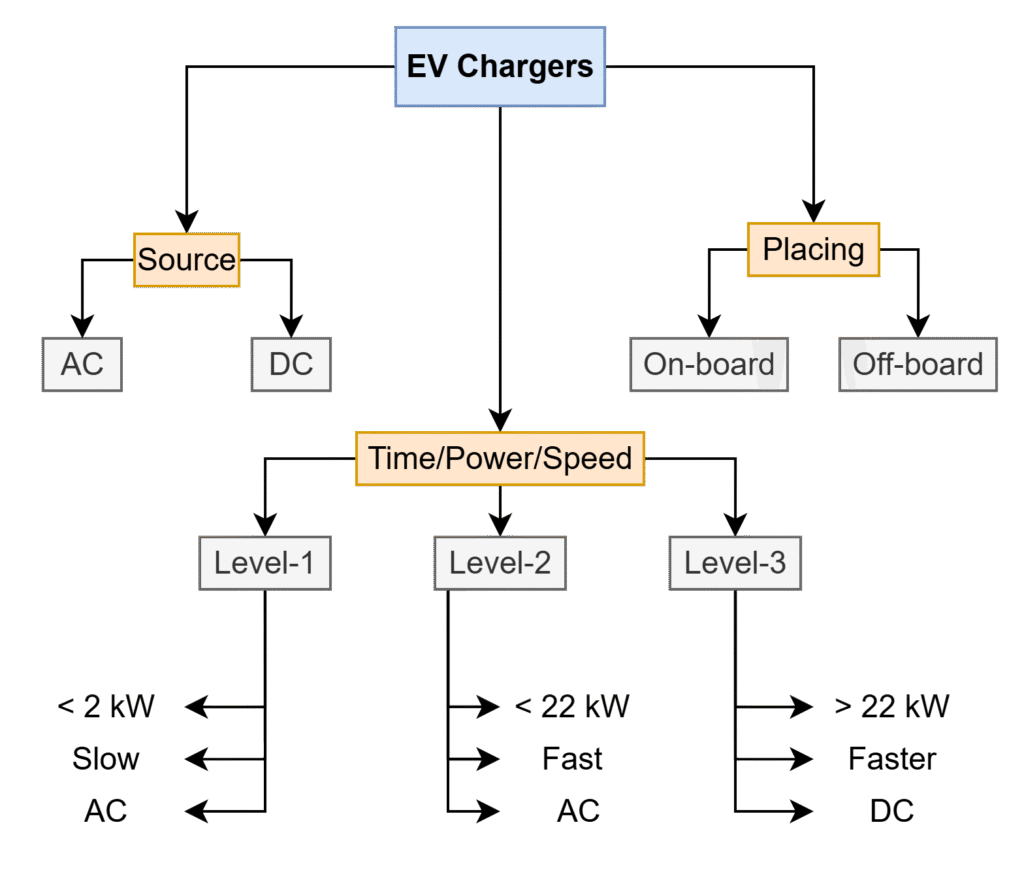
Any electric vehicle (EV) charger can be classified based on its placing, source and speed as shown in below.
Based on Charger Placement
On-board Charger:
It means the charger is equipped inside the vehicle. Only one supply cable (AC) comes to vehicle port for connecting with charger and then charge the battery pack which are inside the vehicle.
Eg.: high power car chargers
Off-board Charger:
It means the charger is outside the vehicle. Only charger output cable (DC) goes to vehicle port to connect with the charger pack which is inside the car.
Eg: Mobile/laptop chargers
Based on Charging Power Source
The AC cable connects charge the battery pack by connecting through on-board charger which is placed inside the vehicle.
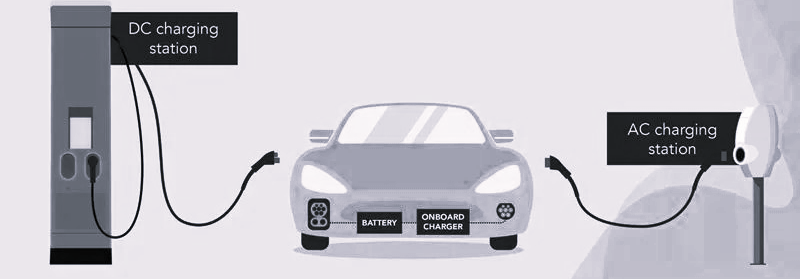
DC cable connects directly to battery pack bypassing the on-board charger. DC charging station have the charger inside the charging station box.
Based on Charging Speed/Power
AC chargers come up with low power and hence takes more time to charge the battery pack. Due to no power conversion modules inside AC charging stations, small in size. Based on power level it sub-divided into 2 levels
- Level-1 AC chargers: <2 kW – 2 wheelers
- Level-2 AC chargers: <22 kW – 2/3/4 wheelers
DC chargers come up with high power and hence takes less time to full-charge the battery pack. The power conversion modules are equipped inside the stations, hence large in size. These are the fast chargers and come up with high power levels more than the 22 kW.
- Level-3 DC chargers: >22 kW – 3/4 wheelers, buses and trucks can charge with DC charging stations.
Leave a Reply