Hysteresis means lagging.
The Hysteresis loop is used to understand the properties of the magentic core material. It is an important paremater in the selection of core material for various applications.
We know, when placing the magnetic material inside the current carrying electrical circuit, EMF will be produced.
In magnetic field, a magnetic bar is connected to the magnetic field (B), whereas an electric circuit pertains to the magnetic field intensity (H).
Hysteresis menas lagging
The magnetic field (B) consistently lags behind the magnetic field intensity (H) in all circumstances. Hence hysteresis is a curve between the B and H. Therefore, hysteresis loop is also called as BH curve.
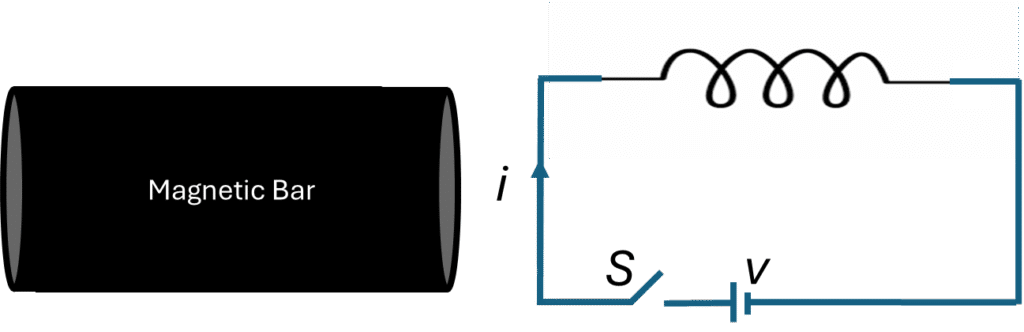
- Initially switch is open, no current flows. Hence, field intensity is ZERO.
- Since no current in electric field, no magnetic field develops inside the magnetic field. Hence, domains in ferro-magnetic material are in random order as shown below figure. Therefore, net magnetic field is ZERO.
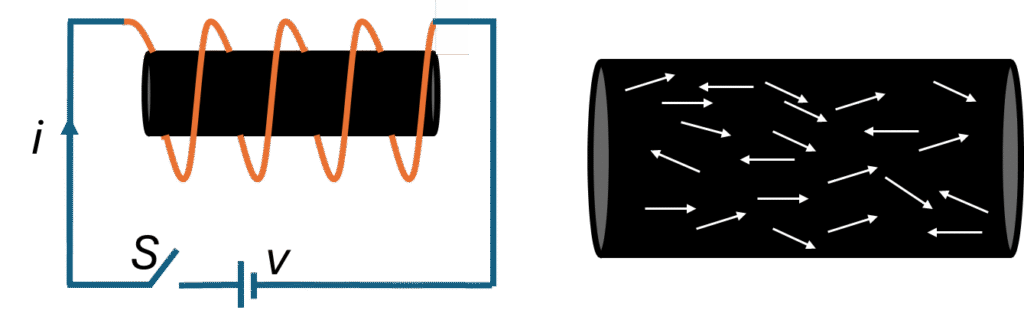
H = 0 –> B = 0
- When switch is closed, current starts flow in circuit.
- A magnetic field begins to form, causing the domains within the material starts to align in the same direction as the flow of current.
- Magnetic field increase with respect to field intensity or current.
- All the domains within the magnetic bar have aligned in a uniform direction, leading to the maximum development of the magnetic field, as there are no other domains present to further strengthen it. Therefore, even with an increase in magnetic field intensity, the magnetic field will not rise beyond this point. This condition is referred to as the saturation point. This material is fully magnetized.
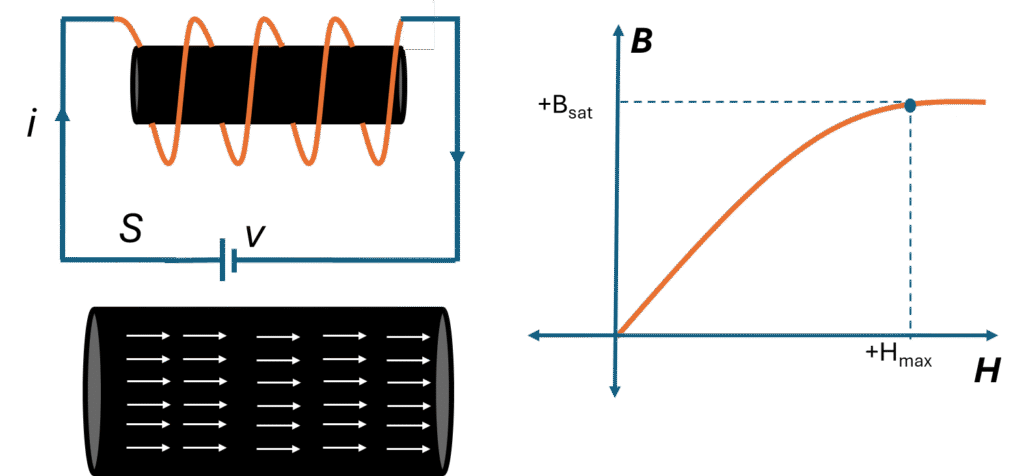
H = Hmax –> B= Bsat
- When the switch is opened, the flow of current ceases. Once the current stops, the magnetic domains begin to return to their original random orientations. As a result, the magnetic field starts to diminish. However, not all domains revert completely to their initial states even when there is no current flowing. This phenomenon leaves some residual magnetic field present. Such materials are referred to as partially magnetized materials.
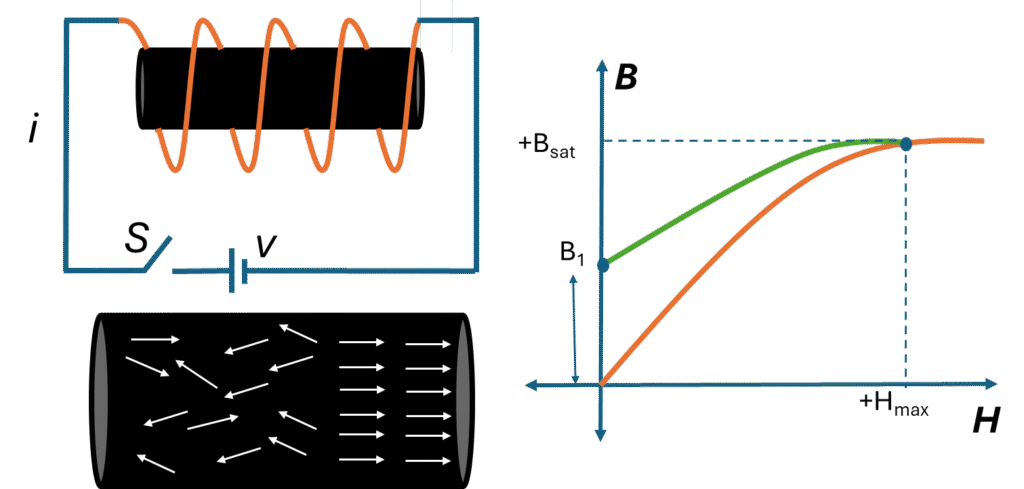
H = 0, but B = B1
- To eliminate this residual magnetic field, a reverse current must be applied, which means changing the direction of the current. This can be achieved by reversing the polarity of the voltage source.
- When the voltage source is reversed and the switch is closed, the domains begin to realign in accordance with the direction of the current. As a result, the magnetic field starts to diminish. Consequently, some domains align in one direction while others point in the exact opposite direction. Thus, the net magnetic field becomes ZERO.
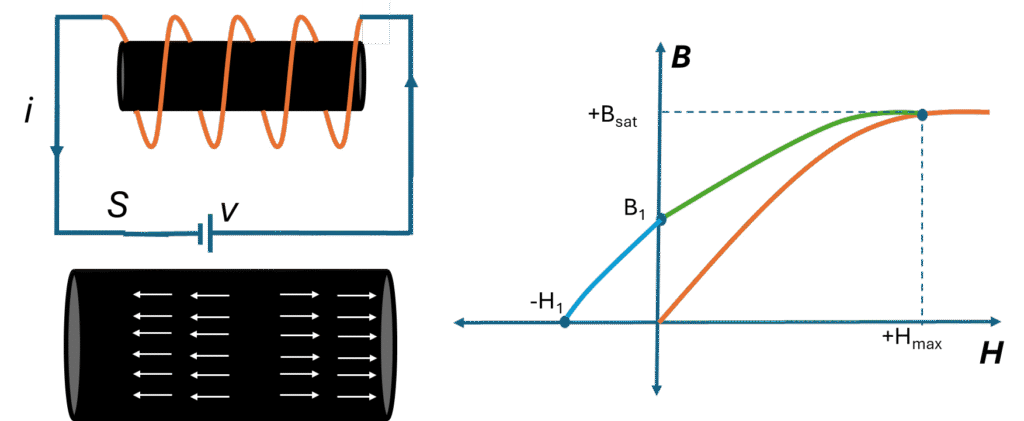
H = -H1, then B = 0
- If an increasing intensity is applied in the same direction, the magnetic field begins to strengthen in that direction. Eventually, all the domains align uniformly in accordance with the current’s direction.
- When all the domains are aligned in the same direction, the magnetic field reaches its saturation point. This indicates that further increases in field intensity will not result in an increase in the magnetic field. This stage is referred to as magnetic saturation and represents the maximum field intensity point for the reverse direction.
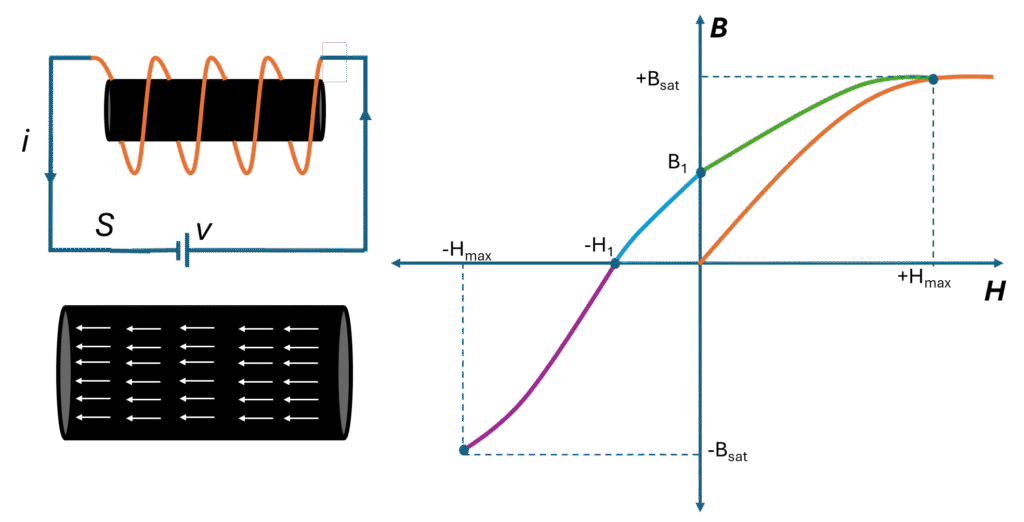
H = -Hmax, then B = -Bsat
- When the switch is opened at this stage, the current flowing in that direction ceases. The magnetic field begins to diminish and eventually reaches a level of partial magnetization.
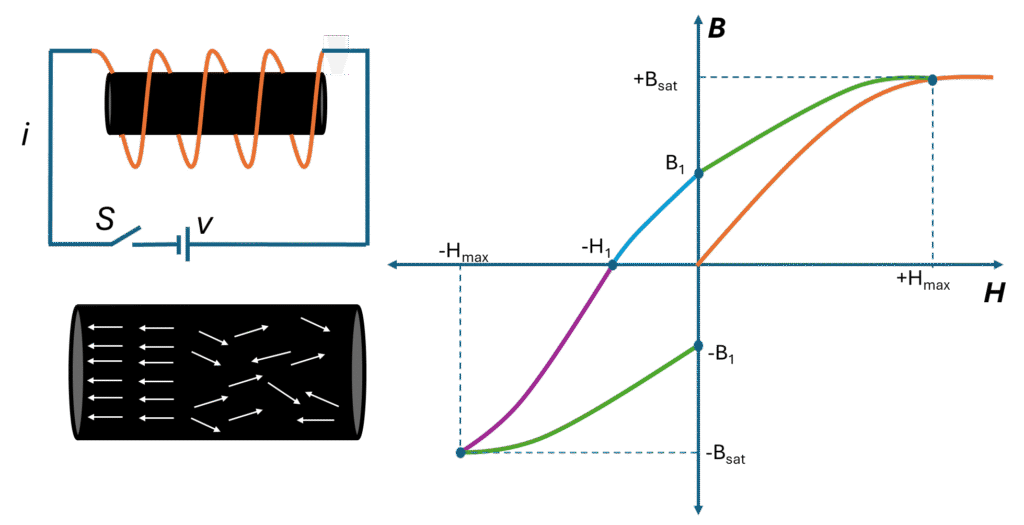
H = 0, but B = -B1
- To eliminate this partial magnetization, the current direction must be reversed by changing the voltage source. As a result, the current flows in the opposite direction, and at a certain point, the net magnetic field becomes ZERO.
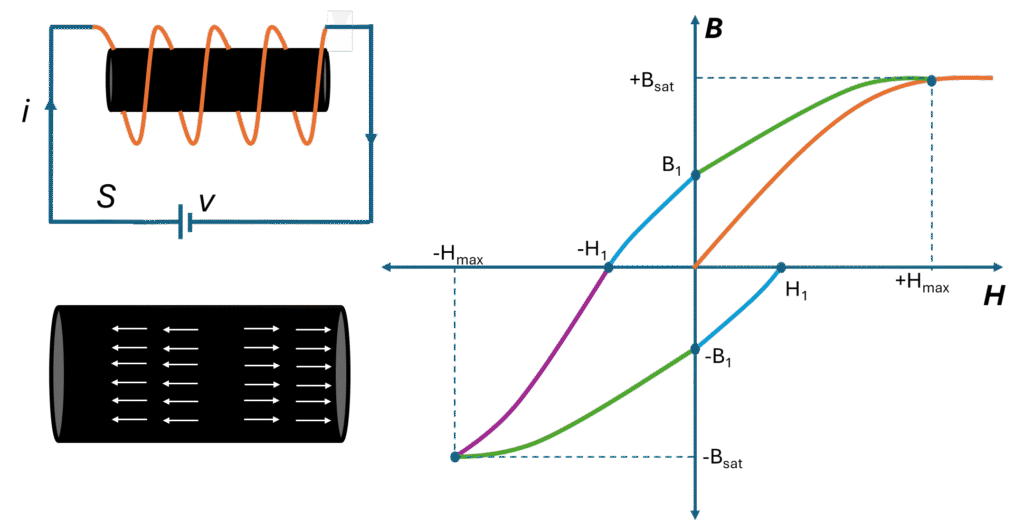
H = H1, then B = 0
- If the field intensity is increased further, the magnetic field begins to form as all the domains align in the same direction, ultimately reaching a saturation point.
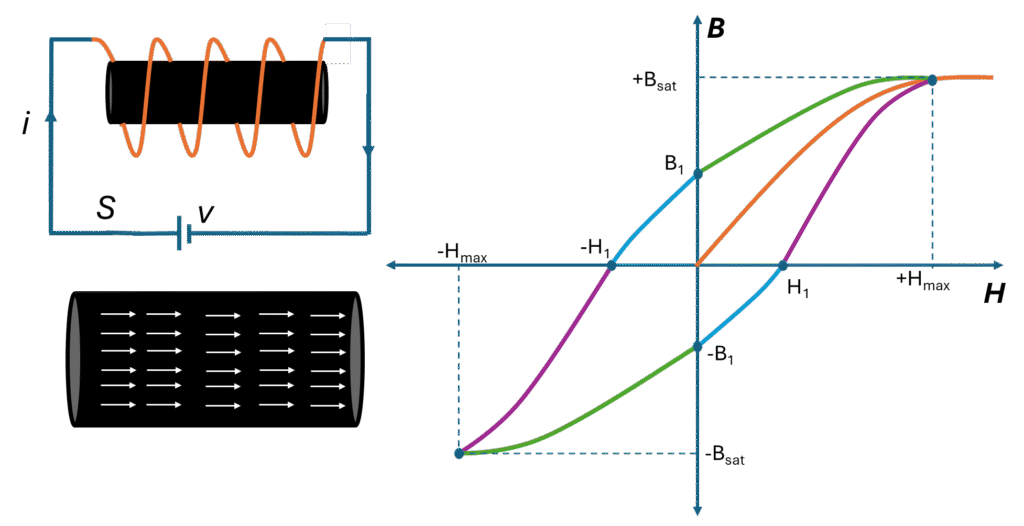
H = Hmax, B = Bsat
This process continues with the magnetic material and never returns to the original state, as illustrated below.
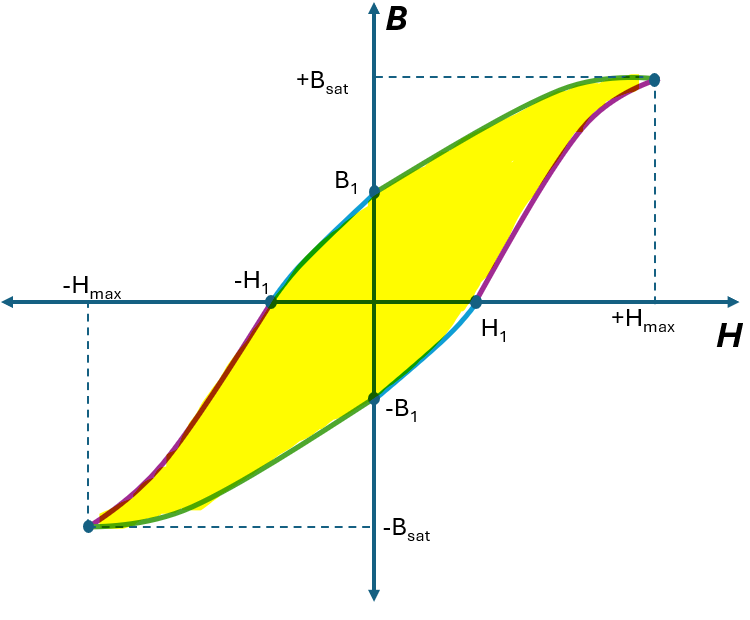
To increase and decrease the magnetic field, energy is required. This energy is released in the form of heat. Each time the domains change direction, some heat is produced. This loss of energy is referred to as hysteresis loss. If a magnetic material has a larger hysteresis loop area, it generates more heat and consequently results in greater losses.
Leave a Reply